Single Phase vs 3-Phase Power: Which Does Your Malaysia Home Need?
Understand the difference between single-phase and three-phase power in Malaysia. When to upgrade, costs involved, and signs your home needs more capacity.
Haziq Rahman
Lead Electrician, ST Certified
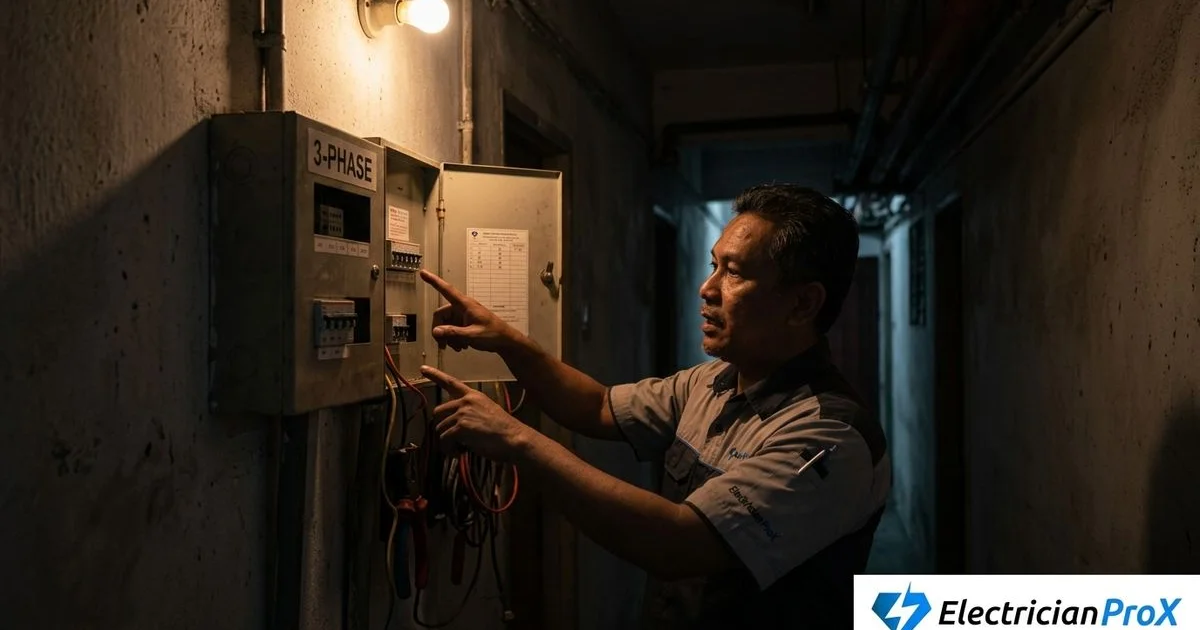
We see blown TNB cut-out fuses and burnt meter casings almost every week here in the Klang Valley.
Most Malaysian homes run on a standard 240V supply, which is perfectly sufficient for basic lighting and ceiling fans. Adding modern high-powered appliances like multiple air conditioners, large water heaters, or Level 2 EV chargers pushes these default systems past their safe limits.
Our team constantly fields questions about Single Phase vs 3-Phase Power: Which Does Your Malaysia Home Need?
Reviewing the current Suruhanjaya Tenaga guidelines will clarify whether your property requires an upgrade to a 415V system. This breakdown covers the specific load limits, safety warnings, and the exact upgrade process.
What Is Single-Phase Power?
Single-phase power delivers 240 volts through a single live wire and one neutral wire. This is the standard supply provided by Tenaga Nasional Berhad (TNB) for most Malaysian residential properties.
Our technicians typically see these setups using a 2-pole Miniature Circuit Breaker (MCCB) that accommodates main loads between 40A and 60A. TNB officially advises homeowners to reconsider this setup once their total household electricity load exceeds 10kW or 50A.
A standard single-phase connection is perfectly safe for basic lighting, standard televisions, and a standard refrigerator.
We always remind customers that keeping peak usage under that 10kW threshold prevents sudden power trips.
Ideal property types for single-phase setups include:
- Apartments and condominiums
- Smaller terrace homes
- Properties without high-draw EV chargers
What Is Three-Phase Power?
Three-phase power delivers 415 volts through three live wires, one neutral pole, and one earth pole. It provides approximately 1.73 times more power than a standard single-phase connection.
Our installation projects for larger properties almost always utilize a 3-pole MCCB to safely handle electrical loads ranging from 60A to 100A.
Key advantages of this configuration include:
- Continuous power even if one phase trips
- Support for heavy 11kW or 22kW EV chargers
- No light flickering when heavy motors start
We recommend this expanded supply specifically for properties requiring heavy continuous power draws. TNB heavily regulates these installations to ensure the neighborhood grid remains stable.
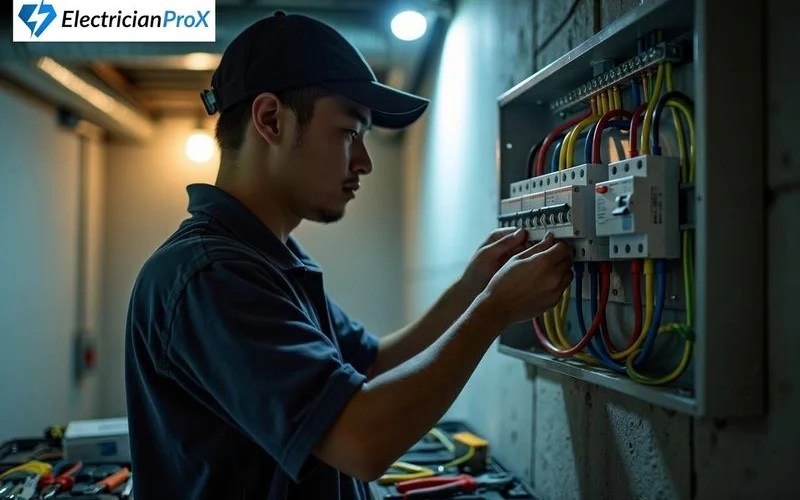
Key Differences
| Feature | Single-Phase | Three-Phase |
|---|---|---|
| Voltage | 240V | 415V |
| Max capacity | 40-60A (~10-12kW) | 60-100A per phase (~43-72kW) |
| EV Charger Limit | Max 7.4kW (32A) | Up to 22kW |
| Monthly minimum charge | RM 3.00 | RM 9.00 |
| Best for | Standard terrace homes | Large homes, heavy EV users |
| TNB upgrade cost | N/A | RM 1,500-5,000 |
We frequently explain that the initial upgrade cost varies based on your neighborhood infrastructure.
Upgrading an overhead supply is significantly cheaper than replacing underground cables. A standard TNB connection charge for a new three-phase overhead supply is RM 1,700, but they deduct RM 450 for your existing single-phase setup, leaving a base connection fee of RM 1,250.
Our team notes that local council fees for road digging will increase this total if you require underground routing.
Signs You Need a Three-Phase Upgrade
A strained electrical system presents clear warning signs before failing completely.
We inspect hundreds of DB boxes annually across the Klang Valley. The symptoms of an overloaded single-phase supply are remarkably consistent.
Ignoring these indicators often leads to melted wiring insulation or dangerous meter fires.
Frequent DB Box Tripping
A tripped Miniature Circuit Breaker (MCB) is a clear safety signal that your current supply cannot handle the load. We often trace mysterious power trips during heavy rain to improper outdoor wiring rather than a true capacity issue.
Many contractors take shortcuts by using standard 1.5mm or 2.5mm indoor cables for auto-gates or pillar lights. Moisture seeps into these unshielded cables, causing leakage current that instantly trips your Earth Leakage Circuit Breaker (ELCB).
Our electricians strongly advise replacing exposed outdoor lines with properly rated armoured cables before assuming you need a full capacity upgrade.
Multiple High-Draw Appliances
Running three or more air conditioners simultaneously is TNB’s standard baseline for recommending a three-phase upgrade. A single 2.0HP inverter air conditioner draws around 1,500 watts of continuous power.
We see older terrace homes struggle when families run several split units alongside an electric oven or induction cooktop.
Large instantaneous water heaters operating above 6kW also place massive strain on a single 60A main breaker. Upgrading ensures these heavy motors do not cause your lights to flicker or your breakers to overheat.
EV Charger Installation Requirements
Electric vehicle chargers demand continuous, heavy current for several hours at a time. We align strictly with Suruhanjaya Tenaga (ST) guidelines, which note that a single-phase system can safely support a maximum 7.4kW (32A) charger.
TNB issued an official warning in late 2025 regarding a sharp increase in blown cut-out fuses and meter fires. These incidents were frequently caused by homeowners overloading single-phase connections with 7kW chargers.
Our teams mandate proper grounding with a loop impedance below 1 ohm for any new charger installation to prevent severe electrical hazards. Installing a faster 11kW or 22kW wallbox absolutely requires a structural supply upgrade.
Upgrade Process
The upgrade process requires strict compliance with the Electricity Supply Act 1990. We guide clients through this heavily regulated procedure to ensure complete safety and legal compliance.
Only a Suruhanjaya Tenaga (ST) registered electrical contractor can legally perform this work. Do not hire uncertified handymen for high-voltage main line modifications.
Our administrative team handles the paperwork directly through the myTNB portal on your behalf. Here is the exact workflow:
- Load assessment: A certified electrician calculates your total electrical load and verifies your neighborhood infrastructure.
- TNB application: The contractor submits your required documents and load details via the myTNB portal for official approval.
- Internal wiring: The technician upgrades the DB box, installs Type A RCCBs for EV safety, and runs PVC or XLPE conduits for the electrical wiring.
- TNB installation: Utility personnel arrive to install the new three-phase meter and pull the upgraded supply cable from the street.
- Testing and certification: The ST-registered electrician conducts loop impedance testing and certifies the final installation.
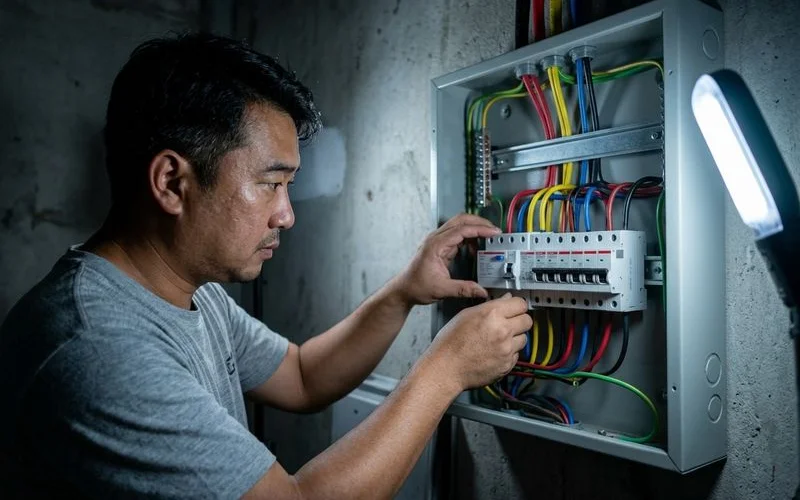
Costs Involved
The financial investment depends heavily on the distance from the street pole to your meter. We break down the core expenses so you can budget accurately for your specific property type.
TNB requires an increased Security Deposit when moving to three-phase power, as they anticipate a higher monthly billing volume. You must clear all outstanding single-phase bills before TNB will process the new connection.
Our detailed quotations always outline the difference between standard overhead wiring and the more expensive underground cable trenching.
| Item | Cost Range |
|---|---|
| TNB connection charge (Overhead) | RM 1,250-1,700 |
| TNB security deposit top-up | RM 200-500 |
| Three-phase DB box (with Type A RCCB) | RM 1,200-2,800 |
| Internal wiring upgrade & conduits | RM 2,000-5,000 |
| Electrician labour & ST certification | RM 1,000-3,000 |
| Total estimate | RM 5,650-13,000 |
Single Phase vs 3-Phase Power: Which Does Your Malaysia Home Need?
Not every home requires a massive capacity expansion. We frequently solve frustrating power cuts simply by reorganising how power is distributed across your existing circuits.
This technique is called load balancing. An electrician moves heavy appliances onto separate, dedicated breakers to prevent one specific line from drawing too much current.
Load balancing prevents single-point circuit overloads, often saving homeowners the thousands of ringgit required for a full TNB three-phase upgrade.
Our diagnostic checks often reveal that upgrading your worn-out 40A MCBs to modern replacements is a much cheaper fix than a full TNB application.
Answering the question of Single Phase vs 3-Phase Power: Which Does Your Malaysia Home Need? begins with a physical inspection. Have a professional evaluate your actual usage before spending thousands of ringgit.
Book a free load assessment with Electrician ProX to find out if your home truly needs a three-phase upgrade.
Need Professional Help?
Contact our Suruhanjaya Tenaga certified team for a free consultation.
Get Free Quote
)